A standalone e-signature specialist vs. e-signing bundled into Adobe’s PDF stack — here is how DocuSign and Adobe Acrobat Sign actually compare on cost, workflow depth, and ecosystem fit.
| Category | DocuSign | Adobe Acrobat Sign |
|---|---|---|
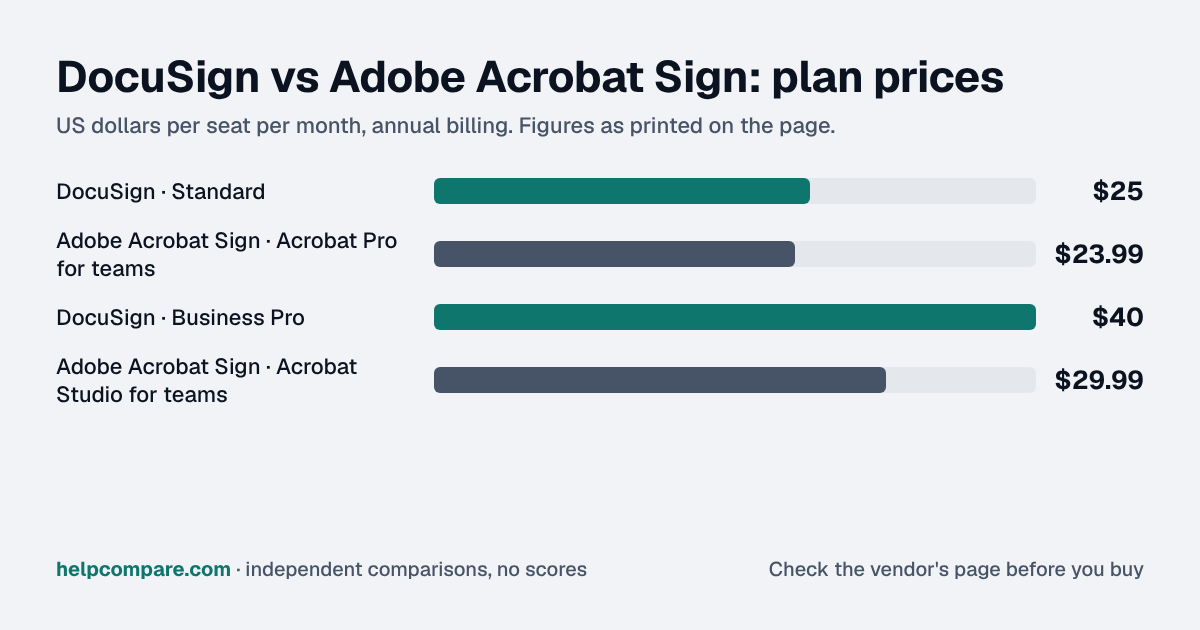
| Entry plan (annual) | ~$10–15/mo — Personal, 1 user, 5 envelopes/mo | $16.99/license/mo — Acrobat Standard for teams |
| Standalone business tier | ~$25–30/user/mo — Standard, 100 envelopes/user/yr | ~$23/user/mo — Acrobat Sign Business, 100 envelopes/user/yr |
| Advanced tier | ~$40–45/user/mo — Business Pro | $29.99/license/mo — Acrobat Studio (adds AI Assistant) |
| Enterprise | Custom — contact sales | ~$40/user/mo+ — Acrobat Sign Enterprise, unlimited envelopes |
| AI product | IAM (Intelligent Agreement Management): $40–$75/user/mo | Acrobat AI Assistant — bundled in Studio or ~$5–$12/user/mo add-on |
| Deepest ecosystem tie-in | Own large partner network; strong CRM/HRIS connectors | Microsoft 365 & Teams, plus native PDF/Adobe workflows |
| Free plan | No — free trial only | No — free trial only |
| Best suited for | Standalone e-sign need, integration-heavy sales/HR workflows | Teams already invested in Microsoft 365 or Adobe/PDF stacks |
DocuSign remains the deeper standalone e-signature product at lower price points — bulk send, conditional routing, and web forms are available well before Adobe reaches its Enterprise tier. Adobe’s advantage is that e-signing comes bundled with real PDF editing, so if your team is already paying for Acrobat or Microsoft 365, signing is effectively an add-on rather than a second subscription.
Both are enterprise-grade on compliance — DocuSign covers eIDAS, HIPAA, and SOC 2; Adobe Acrobat Sign adds eIDAS, HIPAA, GDPR, FERPA, GLBA, and FDA 21 CFR Part 11, tied to native PDF/ISO 32000 standards. The bigger differentiator is ecosystem: DocuSign has the larger, more mature CRM/HRIS integration network, while Adobe is unmatched for Microsoft 365 and native PDF workflows.
DocuSign launched IAM (Intelligent Agreement Management) with its Iris AI agents in May 2026, adding autonomous contract review and MCP integration with Claude, Gemini, and ChatGPT. Adobe rolled AI into its Acrobat AI Assistant (bundled in the Studio tier or as a paid add-on) alongside an April/June 2026 Acrobat price increase.
Illustrative estimate based on publicly listed pricing as of September 2026. Always confirm current rates before purchasing.
E-signature is a standalone, business-critical workflow — you need bulk sending, conditional routing, or deep CRM/HRIS integrations, and want the most mature dedicated e-sign product on the market.
Your team already works inside Microsoft 365 or the Adobe/PDF ecosystem and would rather have document editing and signing in one subscription than run two separate tools.
Compare DocuSign against PandaDoc too, and browse every e-signature head-to-head we cover.
Both offer a free trial or demo — confirm current pricing directly with the vendor before you sign.
At comparable business tiers both land around $20–$30/user/month — DocuSign Standard (~$25–30/user/mo) versus Acrobat Sign Business (~$23/user/mo). DocuSign’s Personal plan is cheaper for solo use ($10–15/mo) but is capped at 5 envelopes a month.
Yes, through general PDF and document workflows, but it isn’t natively bundled the way Adobe’s own Acrobat-plus-Sign combination is.
Neither offers an ongoing free plan in 2026; both offer free trials only.
Adobe Acrobat Sign, due to its deeper native integration with Microsoft 365, Teams, and SharePoint compared with DocuSign’s more general-purpose integration approach.
DocuSign, via its IAM (Intelligent Agreement Management) platform and Iris AI agents for contract analysis and risk extraction, is currently ahead of Adobe’s more document-editing-focused AI Assistant.
Yes, but DocuSign offers bulk send starting at its Business Pro tier, while Adobe’s bulk request feature is available starting at Acrobat Pro, one tier lower in Adobe’s ladder.
Both are enterprise-grade with comparable certifications. Adobe Acrobat Sign additionally ties into native PDF/ISO 32000 document standards, which can matter for document-heavy regulated workflows.