Skip to content
Start here
Cloud Storage

Box vs Google Workspace: Which Cloud Storage Tool Fits Your Business in 2026?

Box is a dedicated content-management and file-storage product. Google Workspace bundles Drive storage with Gmail, Docs, Sheets and Meet as one office suite — the comparison is really storage-plus-nothing-else against storage-plus-a-full-office-suite.

Box logoBusiness Starter $5/user/mo (annual, 3-user minimum, up to 10 users)

Box

VS
Google Workspace logoBusiness Starter $7/user/mo (annual commitment)

Google Workspace

Bill Belcamino
Bottom line up frontby Bill Belcamino, founder of HelpCompare
Editorial assessment

Bottom line up front: Should a small business pay for Box or just use Google Workspace?

It turns on whether you already have email: Box Business Starter is $5/user/mo and is storage only, while Google Workspace Business Starter at $7/user/mo adds Gmail on your domain, Docs, Sheets and Meet.

Storage runs the other way, with Box Starter giving 100 GB per user against Workspace's 30 GB per person, and Box bundles Box Sign but needs 3 to 10 users. The expensive mistake is running both. A Workspace company that adds Box usually ends up with files split across two drives, nobody sure which copy is current, and two sets of permissions to unwind every time someone leaves. Pick one system of record for company files and retire the other. If email and office apps already live somewhere else, Box is the cleaner storage-only buy.

My read of the verified data on this page, checked against vendor sources on September 23, 2026. Disagree or spot an error? Tell Bill

Verified data

Box vs Google Workspace: quick facts

At a glanceBoxGoogle Workspace
CategoryCloud Storage
Entry priceBusiness Starter $5/user/mo (annual, 3-user minimum, up to 10 users)Business Starter $7/user/mo (annual commitment)
Free planNo business free plan — 10 GB personal-only free tier exists separatelyNo free plan for Google Workspace — a 14-day trial is offered

Is Box cheaper than Google Workspace?

Depends what you’re actually buying. Per seat, Box is $2 cheaper ($5 vs $7), but Google Workspace replaces the need for separate email and office-app subscriptions, which Box does not touch at all. If you already pay for Gmail/Office elsewhere, Box is the cheaper pure-storage option; if you need email and docs too, Workspace bundles more for $2 more.

Verified data

Box vs Google Workspace at a glance

CategoryBoxGoogle Workspace
Entry priceBusiness Starter $5/user/mo (annual)Business Starter $7/user/mo (annual)
What’s includedStorage, e-signature, workflow toolsStorage (30 GB pooled/person) plus Gmail, Docs, Sheets, Slides, Meet, Calendar
Seat minimum / cap3–10 users on StarterNone published on Starter
Business emailNot includedIncluded (Gmail on your domain)
Video conferencingNot includedGoogle Meet included
E-signatureBox Sign includedNot included at Starter
Admin consoleYesYes
Built forContent management, file storage, workflowAll-in-one office suite (email, docs, storage, meetings)

Verified September 23, 2026Prices recorded from each vendor’s own pricing page. See sources

Explore the numbers

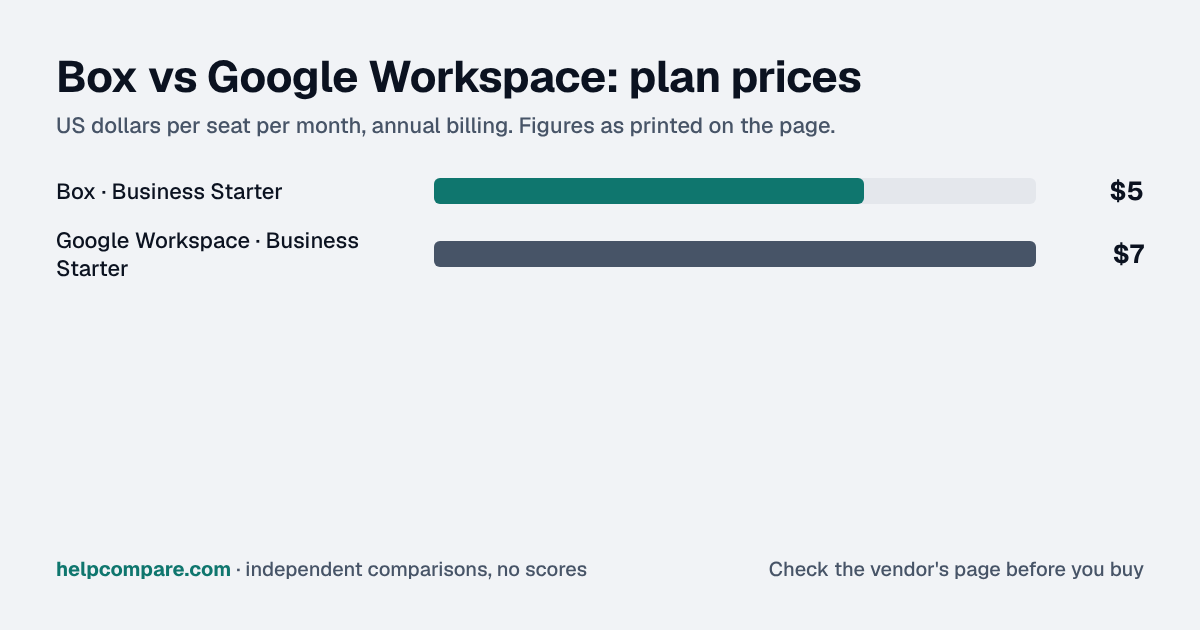
Box vs Google Workspace: the prices as a chart

Box and Google Workspace: plan prices side by side

Plan price: US dollars per seat per month, annual billing

  • Box · Business Starter$5
  • Google Workspace · Business Starter$7

BoxGoogle Workspace

Prices exactly as printed in the comparison table on this page (annual billing), in the table’s own tier order: Entry price.

What Box and Google Workspace cost per month for a team

5 seats: monthly cost = seats × the per-seat price on this page (annual billing)

  • Box · Business Starter: 5 × $5$25
  • Google Workspace · Business Starter: 5 × $7$35

10 seats: monthly cost = seats × the per-seat price on this page (annual billing)

  • Box · Business Starter: 10 × $5$50
  • Google Workspace · Business Starter: 10 × $7$70

25 seats: monthly cost = seats × the per-seat price on this page (annual billing)

  • Box · Business Starter: 25 × $5$125
  • Google Workspace · Business Starter: 25 × $7$175

50 seats: monthly cost = seats × the per-seat price on this page (annual billing)

  • Box · Business Starter: 50 × $5$250
  • Google Workspace · Business Starter: 50 × $7$350

BoxGoogle Workspace

An example, not a quote: team size times the per-seat prices printed on this page. It leaves out tax, add-ons, discounts and any plan limits. Where a plan has a minimum number of seats, the minimum is used.

List prices from this page’s own comparison table, not a quote. Plans differ in what they include.

Business-plan prices in USD from box.com/pricing and workspace.google.com/pricing, both checked September 23, 2026.

Editorial assessment

How they actually differ

This is less a head-to-head on storage and more a question of whether you want a dedicated storage product or a full office suite that happens to include storage.

What you’re really buying

Box Business Starter is file storage, sharing and content workflow — nothing else. Google Workspace Business Starter is business email on your own domain, Docs, Sheets, Slides, Meet and Calendar, with 30 GB of pooled Drive storage per person as one piece of the bundle, not the whole product.

Storage amount

Box Starter pools 100 GB per user (3–10 users). Google Workspace Business Starter pools 30 GB per person — less storage per head at Starter, but bundled with email and office apps that Box does not provide at any tier.

Moving between them

Files themselves rarely have to be re-uploaded by hand: all three offer a desktop sync client, so once the new account is set up, moving the working copies means downloading from the old provider and uploading to the new one, or using a third-party cloud-to-cloud transfer tool if the folder tree is large. Sharing links and permissions do not carry over and are rebuilt by hand.

Box

Pros

  • $2 a seat cheaper than Workspace Starter
  • More storage per user at entry (100 GB vs 30 GB)
  • E-signature bundled in
  • Purpose-built for content workflow

Cons

  • No email, docs or meeting tools — buy those elsewhere
  • 3-user minimum, 10-user cap on Starter
  • No business free plan
  • Narrower product than a full office suite

Google Workspace

Pros

  • Full office suite: email, Docs, Sheets, Slides, Meet
  • No published seat minimum on Starter
  • One bill instead of separate storage and email subscriptions
  • Widely adopted, easy onboarding for most teams

Cons

  • Less storage per person at entry than Box
  • No e-signature bundled at Starter
  • No business free plan
  • Not a dedicated content-management product like Box
Verified data

Cost calculator: what does your team actually pay?

Box

 
$0/mo

Google Workspace

 
$0/mo
 

Business-plan list prices, billed annually, checked September 23, 2026. Box Business Starter requires 3–10 users; Google Workspace Business Starter has no published seat minimum. Promotions and taxes are not included.

Choose Box if…

You already have email and office apps elsewhere and want a dedicated, cheaper storage and content-workflow product with e-signature included.

Choose Google Workspace if…

You want one bill for business email, office apps, video meetings and storage together, and don’t need Box’s content-workflow features.

Total cost over time

Uses your selections above. Estimate excludes add-ons, overages, and negotiated discounts.

Ready to pick your cloud storage tool?

Box and Google Workspace both offer trials. If you’re also shopping for business email, weigh Workspace’s bundle against buying Box plus a separate email provider.

Verified data

Box vs Google Workspace: security, offline & remote work

How Box and Google Workspace compare on compliance reports, sign-in controls, offline access and the setup details that matter for remote, hybrid and in-office teams. Every value links to the vendor page it came from.

What we checkedBoxGoogle Workspace
Security & compliance
SOC 2 reportSOC 2 Type IIsourceSOC 2 Type IIsource
ISO/IEC 27001CertifiedsourceCertifiedsource
Other certificationsISO/IEC 27017, ISO/IEC 27018, ISO/IEC 27701, FedRAMP High, DoD IL4, C5, IRAP, ISMAP, HDS, PCI DSS, HIPAA/HITECH, SOC 3, FIPS 140-2sourceNot published
HIPAA (BAA)BAA availableEnterprisesourceBAA availablesource
GDPR data processing agreementDPA offeredsourceDPA offeredsource
Single sign-on (SAML/OIDC)YesBusinesssourceYesBusiness Startersource
SCIM user provisioningNot publishedNot published
Two-factor authenticationYessourceYesEnforcement: Business Startersource
Admin audit logYessourceYesBusiness Startersource
Data residency choicesAustralia, Canada, EU, France, Israel, Japan, Singapore, Switzerland, UK, USEnterprise Plus (add-on)sourceUS, EUBusiness Standardsource
Encryption256-bit AES at rest (with AES-256 key wrapping); TLS 1.2 in transitsourceAES-256 at rest and in transit for Drive/Docs filessource
Self-hosting optionNot publishedNot published
Offline access
Offline modeWorks offlineIn Box Drive (desktop), folders marked 'Always keep on device' are downloaded and can be edited offline; changes upload automatically when back online, and conflicting edits by collaborators must be resolved manually.sourceWorks offlineDocs, Sheets and Slides can be created and edited offline in Chrome or Edge once offline access and the Docs Offline extension are turned on; recently opened files are saved locally and sync when back online.source
Desktop appsWindows, macOSsourceWindows, macOSsource
Mobile appsiOS, AndroidsourceiOS, Androidsource
Offline limitsAdmins control Mark for Offline: on for all managed users by default, or limited to select users (up to 100), or disabled.sourceOffline editing needs Chrome or Edge (not private browsing) and the Google Docs Offline extension, set up while online.source
Remote, hybrid & in-office
IP allowlistingNot publishedYesEnterprisesource
Device & session controlsYesDevice Trust minimum requirements (OS version, antivirus, firewall, full disk encryption), device pinning, EDR-triggered session termination and device blocking, and EMM/MDM support for the mobile apps.sourceYesBusiness StarterFundamental endpoint management on all Business editions (remote account sign-out and mobile account wipe, block devices, endpoint verification); Business Plus adds advanced mobile management and remote device wipe; Enterprise adds context-aware access and enterprise endpoint management.source
Office & room hardware—Google sells Google Meet Hardware for meeting rooms as a separate add-on; room booking ('Browse and reserve conference rooms') is on all plans.source
Editorial assessment

What this means for your team

  • Audit reports: both publish a SOC 2 report, and Box and Google Workspace also hold ISO/IEC 27001. Ask each vendor for the report under NDA before you sign; security reviews usually want the latest one.
  • Single sign-on: Box includes it on Business; Google Workspace includes it on Business Starter. If your team signs in through Okta, Microsoft Entra ID or Google, price the Box plan that includes SSO, not its entry plan; Google Workspace includes it on the entry plan.
  • Health data: Box and Google Workspace will sign a HIPAA business associate agreement (Box: Enterprise).
  • Working offline: Box and Google Workspace let you keep working without a connection. Details are in the Offline mode row above.
  • Office-only access: Google Workspace can restrict sign-ins to approved IP ranges on Enterprise. That suits an office network or a company VPN; fully remote teams need a VPN for it to work.
  • Where your data lives: Box lets you choose Australia, Canada, EU, France, Israel, Japan, Singapore, Switzerland, UK, US on Enterprise Plus (add-on); Google Workspace lets you choose US, EU on Business Standard. This matters for teams hiring across the EU, UK or Australia.
  • In the office: Google Workspace: Google sells Google Meet Hardware for meeting rooms as a separate add-on; room booking ('Browse and reserve conference rooms') is on all plans.

Box: worth knowing

  • SecurityBox Zones (in-region data storage) is an add-on for Enterprise Plus and Enterprise Advanced, covering ten regions. source
  • RemoteFor Device Trust checks in the web app, Windows and macOS laptops must have Box Tools installed, so unmanaged home computers may be blocked. source
  • OfflineOffline edits in Box Drive upload automatically on reconnect, and Box Drive resumes pending syncs where it left off. source
  • OfficeBox Zones customers with France or Canada users had to add new Zone-specific endpoints to office firewall and proxy configurations by September 15, 2026. source

Google Workspace: worth knowing

  • RemoteMeet caps meetings at 100 participants on Business Starter, 150 on Standard, 500 on Plus and 1,000 on Enterprise, each up to 24 hours. source
  • OfflineOffline editing of Docs, Sheets and Slides only works in Chrome or Edge with the Docs Offline extension, so plan for that browser on laptops used in the field. source
  • SecurityA full admin data export starts no earlier than 48 hours after it is requested and typically takes 72 hours, up to 14 days. source
  • OfficeBusiness Starter, Standard and Plus are capped at 300 users; larger organisations need an Enterprise plan. source

Checked September 24, 2026 against each vendor’s own trust center, help docs and app pages. Hover or tap “source” to see the exact wording we relied on. “Not published” means we could not find the vendor saying it on its own site; it doesn’t mean the feature is missing. Plan names are the lowest plan the vendor says includes the feature. Security · Offline · Remote vs office · Download the data

Frequently Asked Questions

Is Box cheaper than Google Workspace?

Per seat, yes: $5/user/mo against $7/user/mo, both billed annually. But Workspace bundles business email and office apps that Box does not include at any tier. Prices checked September 23, 2026.

Does Google Workspace include Gmail?

Yes, Business Starter includes Gmail on your own domain, along with Docs, Sheets, Slides, Meet and Calendar.

How much Drive storage do I get with Workspace?

Business Starter pools 30 GB per person. Box Business Starter pools 100 GB per user at the same tier of company size.

Does Box include email or video calls?

No. Box is a dedicated storage and content-workflow product; pair it with a separate email and meetings tool.

Migration Guides

Already decided? Here’s how to actually switch.

Step-by-step migration guides covering what transfers automatically, what doesn’t, and how to handle the gap — in both directions.

Editorial assessment

When to Buy — and When to Walk Away

Every “best cloud storage tool” listicle tells you why to buy. Here’s the other half: the specific conditions under which Box or Google Workspace is the wrong purchase for your team.

Box

Buy Box if:

  • You already have business email and office apps elsewhere
  • You want e-signature bundled in
  • You want more storage per user at the entry tier

Do NOT buy Box if:

  • You need business email or video meetings included
  • You want the simplest possible single bill
  • Your team is below 3 or above 10 users

Google Workspace

Buy Google Workspace if:

  • You want one bill for email, office apps and storage
  • Your team needs Gmail on its own domain
  • You want Google Meet included

Do NOT buy Google Workspace if:

  • You already pay for email elsewhere and just need storage
  • You want e-signature bundled in
  • You need more than 30 GB pooled storage per person at entry

Sources

Prices on this page were recorded from each vendor’s own pricing page on the date shown at the top of the page. Vendors change pricing often — check the live source before you buy.

Every figure is also in our open dataset (JSON and CSV, CC BY 4.0), with its source page and verification date. See how we research pricing.

Cite this page: HelpCompare, “Box vs Google Workspace”, helpcompare.com/box-vs-google-workspace/ (updated ).

Source links on this site are checked every month; last check . How sources are checked.

Start with the job

Guides for the jobs this software does

Plain-language guides: the steps, what to check before you buy, common mistakes, and every tool it takes with verified prices.

Need sign-off?

Turn this into a one-page decision brief

Verified prices costed for your team size, a check against your must-have requirements, the questions to settle before you sign, and a source for every figure. Print it, or paste it into an email to whoever approves the spend.

Build a decision brief

From shortlist to switched

Built for the leader who owns the selection, answers for the spend, drives the rollout, and lives with the results. HelpCompare covers the whole decision, not just the first step.

Bill Belcamino, founder of HelpCompare
About the author

Bill Belcamino

Founder and author, HelpCompare

Engineer by training, operator by experience, marketer by choice. Bill spent eight and a half years as an engineer at HP, was COO of Auctiva (the number one third-party selling platform on eBay, past 200,000 users) and ran Google’s $70M/year search syndication partnership at Alot.com. Then he spent 13 years building his own web properties with his own money at stake. He has bought, trialled, integrated and cancelled more SaaS tools than he can count, and started HelpCompare because the real cost of switching tools is the part nobody covers.

“I’ve sat on both sides of the table: the agency recommending the tool and the client paying for it.”

Researched and fact-checked by the HelpCompare team. Pricing on this page was last verified on September 23, 2026. No paid sponsorships, no affiliate commissions.