CRM Platforms — Enterprise

HubSpot vs Salesforce: Which CRM Should You Choose in 2026?

An easy-to-run, unified CRM vs. the deepest, most customizable enterprise platform in the category. Here is the real cost and complexity trade-off.

HubSpot logoFree tier, from $7/seat/mo

HubSpot

VS
Salesforce logoFrom $195/seat/mo (new Core edition)

Salesforce

Quick verdict: HubSpot is faster to set up and far cheaper to run for small and mid-market teams, but its Professional/Enterprise tiers add steep per-seat costs plus onboarding fees and a new usage-credit layer. Salesforce just relaunched its whole pricing structure in September 2026 around three bundled editions (Core, Advanced, Max) that fold Agentforce AI, Slack, and analytics into one price — genuinely deeper and more customizable, but it demands real admin resources and typically a systems-integrator budget to implement well.

HubSpot vs Salesforce at a glance

CategoryHubSpotSalesforce
Free planYes — up to 2 usersNo
Entry paid price$7/seat/mo (Starter, annual)$195/seat/mo (Core, new Sept 2026 edition)
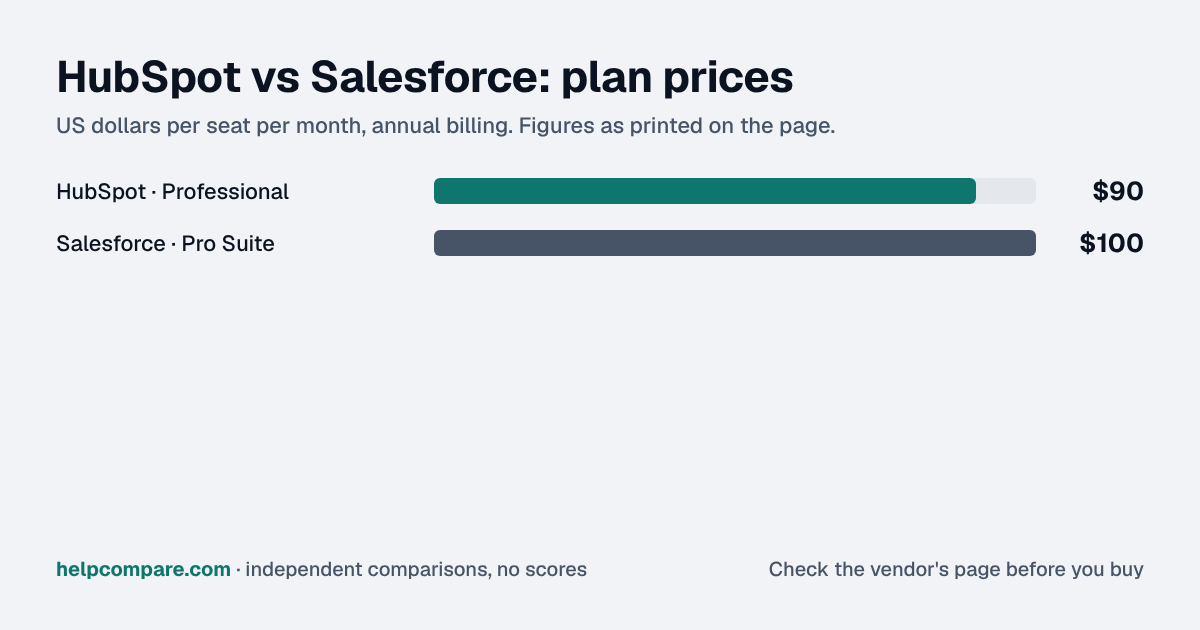
Popular mid tier$90/seat/mo (Professional) + $1,500 onboarding$395/seat/mo (Advanced)
Top tier$150/seat/mo (Enterprise) + $3,500 onboarding$550/seat/mo (Max)
AI includedBreeze AI agents (credit-based usage)Agentforce AI bundled into all editions
Marketplace / ecosystem~1,500+ apps~6,000+ apps (AppExchange)
Customization depthModerate, low-codeDeep (Apex/Flow), steeper learning curve
Typical implementation costLower — often self-serve or light partner helpHigher — often $25k–$250k+ via SI partners
G2 rating4.4/5 (~13,900 reviews)4.4/5 (~25,900 reviews)

How they actually differ

Salesforce just overhauled its entire pricing model. As of September 3, 2026, it replaced its legacy Enterprise/Unlimited/Agentforce 1 editions with three new bundles — Core ($195/user/mo), Advanced ($395/user/mo), and Max ($550/user/mo) — each now folding in Agentforce AI, Slack, Tableau Next analytics, and enterprise security that used to be sold as separate add-ons. That’s a meaningfully different (and simpler) pricing story than the Salesforce most buyers remember.

HubSpot’s usage-credit layer

HubSpot has also shifted toward a hybrid model: seats plus a bundled usage-credit allowance (extra credits cost $9 per 1,000). Combined with mandatory one-time onboarding fees ($1,500 at Professional, $3,500 at Enterprise), the real first-year cost is higher than the seat price alone suggests.

Customization vs. simplicity

Salesforce’s Apex/Flow customization layer and ~6,000-app AppExchange give it more raw depth for complex, multi-department sales orgs — but that power comes with real admin overhead and, commonly, a systems-integrator engagement costing anywhere from $25,000 to well over $250,000. HubSpot’s unified marketing/sales/service UX is intentionally simpler to stand up without dedicated technical staff.

Pros & cons

HubSpot

Pros

  • Free CRM tier, genuinely usable for very small teams
  • Fast to set up without a dedicated admin or consultant
  • Unified marketing + sales + service tools out of the box
  • Lower typical implementation and total cost of ownership

Cons

  • Steep price jump from Starter ($7) to Professional ($90)/seat
  • Mandatory onboarding fees at Professional and Enterprise
  • New usage-credit layer adds billing unpredictability
  • Customization ceiling lower than Salesforce for complex orgs

Salesforce

Pros

  • Just relaunched pricing bundles Agentforce AI, Slack, and analytics
  • Deepest customization layer in the category (Apex/Flow)
  • ~6,000+ app AppExchange ecosystem
  • Built for complex, multi-department enterprise sales orgs

Cons

  • New Core edition still starts at $195/seat/mo — no free tier
  • Steeper admin/consultant learning curve
  • Implementation often requires a paid SI partner ($25k–$250k+)
  • Recent list-price increases (~6% in Aug 2025) on legacy editions

Cost calculator: what does your team actually pay?

HubSpot

 
$0/mo

Salesforce

 
$0/mo
 

Illustrative estimate based on publicly listed pricing as of September 2026. Always confirm current rates before purchasing.

Choose HubSpot if…

You’re an SMB or mid-market team that wants marketing, sales, and service unified in one easy-to-run platform, without hiring a dedicated CRM admin.

Choose Salesforce if…

You’re a larger, more complex sales organization that needs deep customization and AI bundled in, and you have the admin resources (or SI budget) to implement it well.

Ready to pick your CRM?

Both platforms offer a free trial or demo — see current pricing directly from the source.

Frequently Asked Questions

Is HubSpot cheaper than Salesforce?

HubSpot starts at $7/seat/mo (Starter, annual), while Salesforce starts at $195/seat/mo (Core, new Sept 2026 edition). HubSpot is faster to set up and far cheaper to run for small and mid-market teams, but its Professional/Enterprise tiers add steep per-seat costs plus onboarding fees and a new usage-credit layer.

Does HubSpot or Salesforce have a free plan?

HubSpot’s free plan: Yes — up to 2 users. Salesforce’s free plan: No.

Who should choose HubSpot?

You’re an SMB or mid-market team that wants marketing, sales, and service unified in one easy-to-run platform, without hiring a dedicated CRM admin.

Who should choose Salesforce?

You’re a larger, more complex sales organization that needs deep customization and AI bundled in, and you have the admin resources (or SI budget) to implement it well.