Skip to content
Start here
Payroll & HR

OnPay vs Gusto: Which Payroll and HR Tool Fits Your Business in 2026?

Both charge a flat base fee plus a per-worker add-on — and at their entry tiers, the numbers are identical: $49 base plus $6 a head. The real differences show up in add-ons, HR depth and which industries each is built for.

OnPay logo$49 base + $6/worker/mo

OnPay

VS
Gusto logoFrom $49/mo + $6/person

Gusto

Bill Belcamino
Bottom line up frontby Bill Belcamino, founder of HelpCompare
Editorial assessment

Bottom line up front: OnPay or Gusto: where does the price actually split?

Not at entry, where both charge $49 a month plus $6 per worker, so a 10-person team pays $109 a month on either.

The split comes with HR. OnPay sells add-ons one at a time, $15 base + $2/worker for HR and $15 base + $4/worker for time tracking, while Gusto bundles more into Plus at $80 + $12/person or Premium at $180 + $22/person. Price the features you'll need in a couple of years, not today, because payroll is the software you least want to switch mid-year. Also ask each vendor, in writing, who counts as a billable worker, since contractors, seasonal staff and people getting a final paycheck can all move a per-head bill. If you only need time tracking, itemizing on OnPay is the cleaner fit; if you want an HR resource and compliance alerts together, compare against Gusto Premium.

My read of the verified data on this page, checked against vendor sources on September 23, 2026. Disagree or spot an error? Tell Bill

Verified data

OnPay vs Gusto: quick facts

At a glanceOnPayGusto
CategoryPayroll & HR
Entry price$49 base + $6/worker/moFrom $49/mo + $6/person
Free planNo — “Get Your First Month Free” trial offer, not a permanent free tierNo — free account setup, no contracts

Is OnPay cheaper than Gusto?

Neither, at the entry tier — both are $49 base + $6/worker, identical for any team size. The difference shows up once you add HR or time-tracking features: compare OnPay’s itemized add-ons against Gusto’s Plus ($80 + $12/person) or Premium ($180 + $22/person) tiers for your specific feature needs.

Verified data

OnPay vs Gusto at a glance

CategoryOnPayGusto
Entry price$49 base + $6/worker/mo$49 base + $6/person/mo (Simple)
Pricing basisFlat base + per-workerFlat base + per-person
HR add-on$15 base + $2/workerBundled from Plus ($80 + $12/person)
Time tracking add-on$15 base + $4/workerBundled from Plus
Live HR support$65 flat add-onBundled on Premium ($180 + $22/person)
Free trialFirst month freeNo free trial; free account setup
Higher tiersAdd-ons, not plan tiersPlus and Premium plans bundle more HR

Verified September 23, 2026Prices recorded from each vendor’s own pricing page. See sources

Explore the numbers

OnPay vs Gusto: the prices as a chart

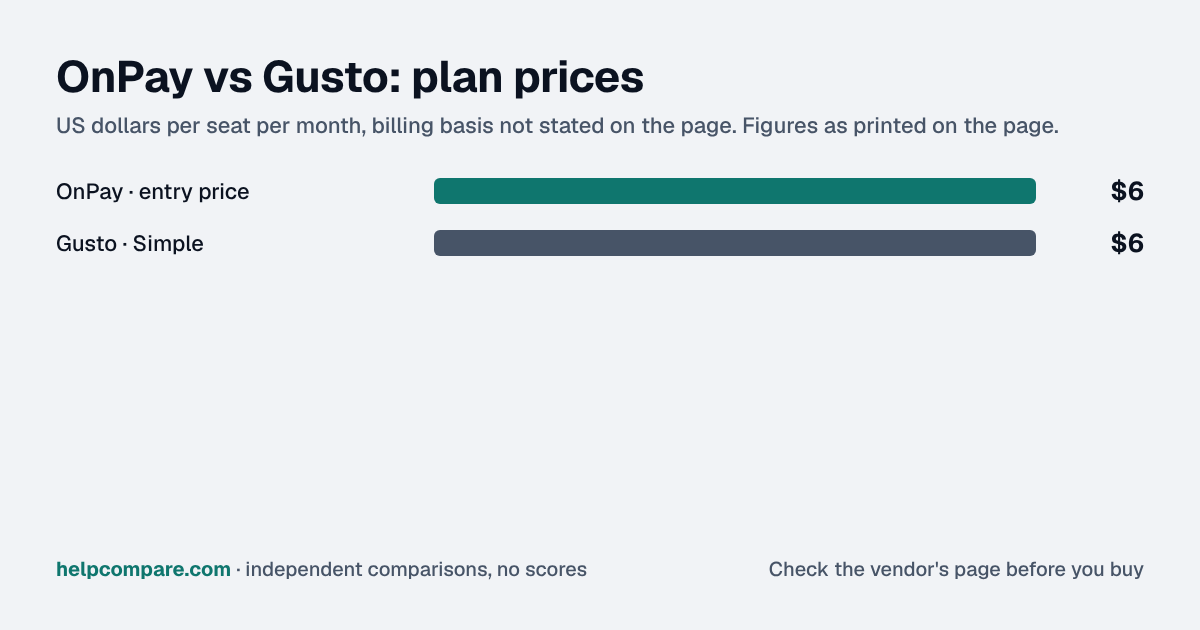
OnPay and Gusto: plan prices side by side

Plan price: US dollars per seat per month, billing basis not stated on this page

  • OnPay · entry price$6
  • Gusto · Simple$6

OnPayGusto

Prices exactly as printed in the comparison table on this page (billing basis not stated on this page), in the table’s own tier order: Entry price.

What OnPay and Gusto cost per month for a team

5 seats: monthly cost = seats × the per-seat price on this page (billing basis not stated on this page)

  • OnPay · entry price: 5 × $6$30
  • Gusto · Simple: 5 × $6$30

10 seats: monthly cost = seats × the per-seat price on this page (billing basis not stated on this page)

  • OnPay · entry price: 10 × $6$60
  • Gusto · Simple: 10 × $6$60

25 seats: monthly cost = seats × the per-seat price on this page (billing basis not stated on this page)

  • OnPay · entry price: 25 × $6$150
  • Gusto · Simple: 25 × $6$150

50 seats: monthly cost = seats × the per-seat price on this page (billing basis not stated on this page)

  • OnPay · entry price: 50 × $6$300
  • Gusto · Simple: 50 × $6$300

OnPayGusto

An example, not a quote: team size times the per-seat prices printed on this page. It leaves out tax, add-ons, discounts and any plan limits. Where a plan has a minimum number of seats, the minimum is used.

List prices from this page’s own comparison table, not a quote. Plans differ in what they include.

Prices in USD from onpay.com and gusto.com, both checked September 23, 2026. OnPay uses “worker,” not “employee” or “person,” on its own pricing page; the structure (flat base plus a per-head add-on) matches Gusto’s Simple plan exactly.

Editorial assessment

How they actually differ

Both are full-service payroll with tax filing included, and both price the same way — a base fee plus a per-head charge — which makes them unusually easy to compare directly.

Bundles vs itemized add-ons

Gusto bundles more HR features into higher-priced tiers: Plus adds time tracking and next-day direct deposit, Premium adds a dedicated HR resource and compliance alerts. OnPay keeps one core plan and prices HR, time tracking and live HR support as separate, itemized add-ons at similarly structured rates, so you only pay for what you actually turn on.

Who they’re built for

Both serve general small-business payroll; check each vendor’s industry-specific features (e.g. agricultural, clergy or multi-state complexity) directly, since HelpCompare’s record does not cover every vertical difference.

Moving between them

Payroll history, tax filings and employee records do not transfer automatically between providers — export year-to-date payroll reports and W-2/1099 data before switching, and plan the move around a quarter or year boundary where possible so tax filings stay clean.

OnPay

Pros

  • Identical entry price to Gusto Simple ($49 + $6/head)
  • Itemized add-ons — pay only for what you use
  • First month free to trial
  • Simple, transparent pricing page

Cons

  • No bundled HR tiers like Gusto Plus/Premium
  • Smaller brand recognition than Gusto
  • HR features require separate add-ons
  • No published free permanent tier

Gusto

Pros

  • Bundled tiers simplify buying more HR at once
  • Well-known brand with a large user base
  • Plus and Premium bundle time tracking and HR support
  • Established integration ecosystem

Cons

  • Higher-tier bundles cost more than itemizing the same features on OnPay
  • No free trial, only free account setup
  • Entry tier (Simple) has the least HR depth
  • Per-person cost rises fast on Premium ($22/person)
Verified data

Cost calculator: what does your team actually pay?

OnPay

 
$0/mo

Gusto

 
$0/mo
 

List prices checked September 23, 2026. Both charge a flat monthly base plus a per-worker add-on. Gusto’s Plus and Premium tiers bundle more HR features at a higher per-person rate; OnPay keeps its core plan flat and sells HR and time tracking as separate add-ons. Promotions and taxes are not included.

Choose OnPay if…

You want to pay only for the specific HR and time-tracking add-ons you actually need, itemized rather than bundled into a higher tier.

Choose Gusto if…

You want more HR features bundled into a single higher-priced plan rather than adding them one at a time, or prefer a more established brand.

Total cost over time

Uses your selections above. Estimate excludes add-ons, overages, and negotiated discounts.

Ready to pick your payroll tool?

OnPay offers a first month free; Gusto offers free account setup with no contract. Run a real payroll cycle through each before committing your team’s data.

Verified data

OnPay vs Gusto: security, offline & remote work

How OnPay and Gusto compare on compliance reports, sign-in controls, offline access and the setup details that matter for remote, hybrid and in-office teams. Every value links to the vendor page it came from.

What we checkedOnPayGusto
Security & compliance
SOC 2 reportSOC 2 Type IIsourceSOC 2 reportType not stated by vendorsource
ISO/IEC 27001Not publishedNot published
HIPAA (BAA)Not publishedBAA availableFor benefits and health-insurance datasource
GDPR data processing agreementNot publishedNot published
Single sign-on (SAML/OIDC)Not publishedNosource
SCIM user provisioningNot publishedNot published
Two-factor authenticationYessourceYesEnforcement: Primary admin setting; applies to admins only (plan not stated)source
Admin audit logNot publishedNot published
Data residency choicesNot publishedUS onlysource
EncryptionAES-256 at rest; TLS 1.2 in transit; hosted on AWSsourceAES-256 at rest (AWS); TLS 1.2 in transitsource
Self-hosting optionNot publishedNot published
Offline access
Offline modeNot documentedNot documented
Desktop appsNot publishedNot published
Mobile appsiOS, AndroidsourceiOS, Androidsource
Remote, hybrid & in-office
IP allowlistingNot publishedNot published
Device & session controlsNot publishedNot published
Office & room hardware—Time Kiosk turns any internet-connected tablet or computer into a shared clock-in station (Plus, Premium, or Time & Attendance Plus Simple add-on).source
Editorial assessment

What this means for your team

  • Audit reports: both state a SOC 2 report on their own sites, but not the same kind: OnPay (Type II) and Gusto (type not stated). A Type I report checks controls at a single point in time; a Type II report tests them over months. If your security team requires Type II, confirm it with Gusto, and ask each vendor for the latest report under NDA.
  • Health data: Gusto will sign a HIPAA business associate agreement (Gusto: For benefits and health-insurance data). We found no BAA offer for OnPay, so keep protected health information out of it.
  • Working offline: OnPay and Gusto don’t document an offline mode. Details are in the Offline mode row above.
  • In the office: Gusto: Time Kiosk turns any internet-connected tablet or computer into a shared clock-in station (Plus, Premium, or Time & Attendance Plus Simple add-on).

OnPay: worth knowing

  • SecurityOnPay's single sign-on lets users log in with Google, QuickBooks or Xero credentials; no SAML connection to a company identity provider is documented. source
  • SecurityEach employee profile has a History > Audit Log of actions involving that employee, but it only shows the last 30 rows. source
  • RemoteEmployees can check pay, hours and PTO from the OnPay Mobile app on iOS and Android; the app is for employees, not admins. source
  • RemoteOutside accountants and bookkeepers can manage client payroll remotely as Outside Collaborators instead of sharing the owner's login. source

Gusto: worth knowing

  • OfflineGusto's Time Kiosk has no offline mode: the kiosk device must be online, so sites without Wi-Fi need a device with cellular data. source
  • OfficeTime Kiosk is limited to Plus, Premium, or Time & Attendance Plus Simple add-on customers who use Time Tracking. source
  • RemoteOn Plus and Premium, provisioning apps grant or remove team members' access to tools like Slack or Zoom from Gusto. source
  • SecurityGusto's SOC 1 and SOC 2 reports are updated annually and available through its Trust Center under NDA; the SOC 2 type is not stated on the security page. source

Checked September 24, 2026 against each vendor’s own trust center, help docs and app pages. Hover or tap “source” to see the exact wording we relied on. “Not published” means we could not find the vendor saying it on its own site; it doesn’t mean the feature is missing. Plan names are the lowest plan the vendor says includes the feature. Security · Offline · Remote vs office · Download the data

Frequently Asked Questions

Is OnPay cheaper than Gusto?

At the entry tier, they’re identical: $49 base + $6 per worker or person. The price difference shows up once you add HR or time-tracking features, which OnPay itemizes and Gusto bundles into higher tiers. Prices checked September 23, 2026.

Does OnPay charge per worker or per employee?

OnPay uses “worker” on its own pricing page; the structure matches Gusto’s per-person add-on exactly ($6 each).

Which has more HR features included at the entry price?

Neither — both entry tiers (OnPay Payroll Essentials, Gusto Simple) are payroll-focused; deeper HR features are add-ons (OnPay) or higher tiers (Gusto).

Does either have a free trial?

OnPay offers a first month free. Gusto offers free account setup with no contract, but not a free trial period.

Migration Guides

Already decided? Here’s how to actually switch.

Step-by-step migration guides covering what transfers automatically, what doesn’t, and how to handle the gap — in both directions.

Editorial assessment

When to Buy — and When to Walk Away

Every “best payroll and HR tool” listicle tells you why to buy. Here’s the other half: the specific conditions under which OnPay or Gusto is the wrong purchase for your team.

OnPay

Buy OnPay if:

  • You want to itemize HR and time-tracking add-ons rather than bundle them
  • You want a first month free to trial
  • The entry price matching Gusto’s matters more than brand recognition

Do NOT buy OnPay if:

  • You want a single bundled tier with more HR built in
  • You prefer the more established brand
  • You want a broader third-party integration ecosystem

Gusto

Buy Gusto if:

  • You want more HR features bundled into one plan
  • You prefer an established, widely used payroll brand
  • You want a broader integration ecosystem

Do NOT buy Gusto if:

  • You want to pay only for the specific add-ons you use
  • You want a free trial period, not just free setup
  • Per-person cost on higher tiers is a concern

Sources

Prices on this page were recorded from each vendor’s own pricing page on the date shown at the top of the page. Vendors change pricing often — check the live source before you buy.

Every figure is also in our open dataset (JSON and CSV, CC BY 4.0), with its source page and verification date. See how we research pricing.

Cite this page: HelpCompare, “OnPay vs Gusto”, helpcompare.com/onpay-vs-gusto/ (updated ).

Source links on this site are checked every month; last check . How sources are checked.

Start with the job

Guides for the jobs this software does

Plain-language guides: the steps, what to check before you buy, common mistakes, and every tool it takes with verified prices.

Need sign-off?

Turn this into a one-page decision brief

Verified prices costed for your team size, a check against your must-have requirements, the questions to settle before you sign, and a source for every figure. Print it, or paste it into an email to whoever approves the spend.

Build a decision brief

From shortlist to switched

Built for the leader who owns the selection, answers for the spend, drives the rollout, and lives with the results. HelpCompare covers the whole decision, not just the first step.

Bill Belcamino, founder of HelpCompare
About the author

Bill Belcamino

Founder and author, HelpCompare

Engineer by training, operator by experience, marketer by choice. Bill spent eight and a half years as an engineer at HP, was COO of Auctiva (the number one third-party selling platform on eBay, past 200,000 users) and ran Google’s $70M/year search syndication partnership at Alot.com. Then he spent 13 years building his own web properties with his own money at stake. He has bought, trialled, integrated and cancelled more SaaS tools than he can count, and started HelpCompare because the real cost of switching tools is the part nobody covers.

“I’ve sat on both sides of the table: the agency recommending the tool and the client paying for it.”

Researched and fact-checked by the HelpCompare team. Pricing on this page was last verified on September 23, 2026. No paid sponsorships, no affiliate commissions.