Notion vs ClickUp: Which Work Management Tool Fits Your Team in 2026?
Notion is a docs-and-databases workspace that teams bend into project tracking; ClickUp is a task platform that bundles docs, chat and time tracking. Here is what each costs per seat and which direction the data moves.
By Bill Belcamino · Last updated September 24, 2026 · Our methodologyResearched and fact-checked by the HelpCompare team
Bottom line up front: Should a team run its work in Notion or ClickUp?
Watch what your team spends the day doing: ClickUp fits teams that assign and track work, and Notion fits teams that mostly write docs and wikis.
ClickUp Unlimited is $7/user/mo billed yearly against Notion Plus at $10/member/mo, with native time tracking and Gantt, while Notion bundles its AI features into Business at $20. Mind the one-way door: ClickUp has a native Notion importer on all plans, but Notion has no ClickUp importer, so leaving ClickUp later means CSV exports and rebuilding by hand. Whichever you choose, name one owner for the workspace structure before you invite everyone, because in a tool this flexible an unowned workspace turns into a junk drawer within a quarter. Build one real project in each free plan first.
No hard seat cap, but collaboration features gated behind paid tiers
Free Forever — unlimited members and guests, 60MB storage, unlimited tasks
Is Notion cheaper than ClickUp?
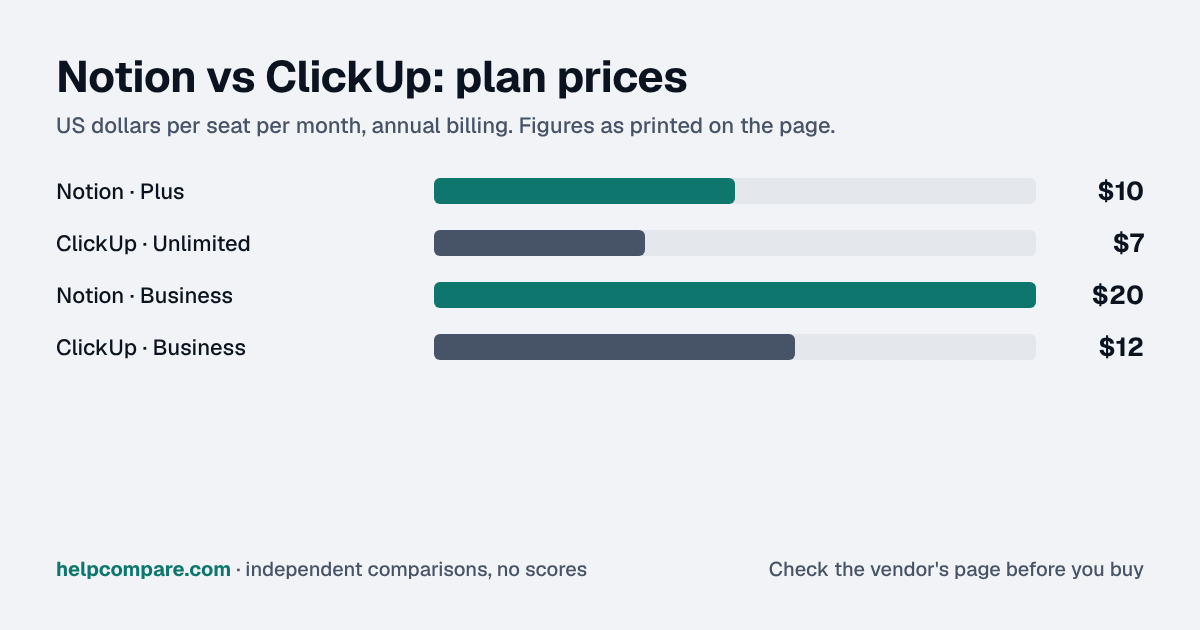
ClickUp, by $3 a seat a month: $7 against Notion’s $10, both billed yearly. At 10 seats that is $70 a month for ClickUp Unlimited against $100 for Notion Plus. On monthly billing the gap is $2 ($10 against $12). Both charge per person, so the difference scales with headcount.
Verified September 24, 2026Prices recorded from each vendor’s own pricing page. See sources
Explore the numbers
Notion vs ClickUp: the prices as a chart
Notion and ClickUp: plan prices side by side
Plan price: US dollars per seat per month, annual billing
Notion · Plus$10
ClickUp · Unlimited$7
Notion · Business$20
ClickUp · Business$12
NotionClickUp
Prices exactly as printed in the comparison table on this page (annual billing), in the table’s own tier order: Entry price, Next tier.
What Notion and ClickUp cost per month for a team
5 seats: monthly cost = seats × the per-seat price on this page (annual billing)
Notion · Plus: 5 × $10$50
ClickUp · Unlimited: 5 × $7$35
Notion · Business: 5 × $20$100
ClickUp · Business: 5 × $12$60
10 seats: monthly cost = seats × the per-seat price on this page (annual billing)
Notion · Plus: 10 × $10$100
ClickUp · Unlimited: 10 × $7$70
Notion · Business: 10 × $20$200
ClickUp · Business: 10 × $12$120
25 seats: monthly cost = seats × the per-seat price on this page (annual billing)
Notion · Plus: 25 × $10$250
ClickUp · Unlimited: 25 × $7$175
Notion · Business: 25 × $20$500
ClickUp · Business: 25 × $12$300
50 seats: monthly cost = seats × the per-seat price on this page (annual billing)
Notion · Plus: 50 × $10$500
ClickUp · Unlimited: 50 × $7$350
Notion · Business: 50 × $20$1,000
ClickUp · Business: 50 × $12$600
NotionClickUp
An example, not a quote: team size times the per-seat prices printed on this page. It leaves out tax, add-ons, discounts and any plan limits. Where a plan has a minimum number of seats, the minimum is used.
List prices from this page’s own comparison table, not a quote. Plans differ in what they include.
Prices in USD from notion.com/pricing and clickup.com/pricing, checked September 24, 2026, using each page’s yearly and monthly toggle. Notion bills per member; ClickUp per user.
Both tools let a team write, plan and track work in one place, but they start from opposite ends: Notion from the document, ClickUp from the task.
Documents first or tasks first
Notion’s unit is the page; a project board is a database view inside a page, and most of its strength is in writing, wikis and linked databases. ClickUp’s unit is the task, with docs, whiteboards and chat attached to the task hierarchy. Teams that mostly write choose Notion; teams that mostly assign and track choose ClickUp.
What the entry tiers include
ClickUp Unlimited ($7) adds unlimited storage, Gantt charts, custom fields, native time tracking and guests with permission control. Notion Plus ($10) adds custom forms and sites, unlimited file uploads and unlimited charts; Notion Agent, AI Meeting Notes and SAML SSO sit on Business ($20).
AI pricing
Notion includes a trial of Notion AI on Free and Plus and bundles its AI features into Business. ClickUp sells AI as an add-on, shown at $9 on its pricing page, with AI Super Credits priced separately.
Moving between them
ClickUp has a native Notion importer on all plans (Workspace settings, Import / Export, Notion): databases arrive as a single Folder, Notion fields become Text custom fields and pages become ClickUp Docs; inline database comments, attachments and button fields do not import. Notion has no ClickUp importer, so the reverse trip is a CSV export from ClickUp and Notion’s CSV import, which creates a database.
Cost calculator: what does your team actually pay?
Notion
$0/mo
ClickUp
$0/mo
List prices billed yearly, checked September 24, 2026. Notion bills per member and ClickUp per user, so both scale with the seat count. ClickUp’s AI add-on and Notion’s higher tiers are not included unless selected. Promotions and taxes are not included.
Choose Notion if…
Your team lives in documents and wikis and only needs light project tracking, or you want AI features bundled rather than sold as an add-on.
Choose ClickUp if…
You need a real task tracker with time tracking, sprints and Gantt out of the box, want the lower per-seat price, or are moving from Notion and want a native importer.
Total cost over time
Uses your selections above. Estimate excludes add-ons, overages, and negotiated discounts.
Ready to pick your work management tool?
Both have free plans. Build one real project in each: if you spend the trial writing, Notion is probably right; if you spend it assigning and tracking, ClickUp is.
Notion vs ClickUp: security, offline & remote work
How Notion and ClickUp compare on compliance reports, sign-in controls, offline access and the setup details that matter for remote, hybrid and in-office teams. Every value links to the vendor page it came from.
Works offlineIn the desktop and mobile apps you can view, edit and create pages offline once they are downloaded to that device; changes save locally and sync automatically when you reconnect.source
PartialOn web, desktop and mobile you can create new tasks (and reminders, except on mobile) and view previously opened tasks and notes offline, but cannot edit existing tasks or notes; new items sync on reconnect.source
Pages must be marked Available offline per device; automatic download of recent and favorited pages only on Business and Enterprise; databases download the first 50 rowsBusiness (auto-download)source
Available on all plans; existing tasks and notes can't be edited offline, subtasks can't be created, and reminders can't be created offline in the mobile appAll planssource
Remote, hybrid & in-office
IP allowlisting
Not published
YesEnterprise (early version; request access via account manager)source
Device & session controls
Not published
YesEnterpriseSession duration and idle timeout limits that apply to every account with access to the Workspace.source
Audit reports: both publish a SOC 2 report, and Notion and ClickUp also hold ISO/IEC 27001. Ask each vendor for the report under NDA before you sign; security reviews usually want the latest one.
Single sign-on: Notion includes it on Business; ClickUp includes it on Enterprise. If your team signs in through Okta, Microsoft Entra ID or Google, price the plan that includes SSO, not the entry plan.
Health data: Notion and ClickUp will sign a HIPAA business associate agreement (Notion: Enterprise; ClickUp: Enterprise).
Working offline: Notion lets you keep working without a connection; ClickUp works offline only in part. Details are in the Offline mode row above.
Office-only access: ClickUp can restrict sign-ins to approved IP ranges on Enterprise (early version; request access via account manager). That suits an office network or a company VPN; fully remote teams need a VPN for it to work.
Where your data lives: Notion lets you choose US, EU, Japan, South Korea on Enterprise; ClickUp lets you choose US, EU, Australia, Singapore on Enterprise. This matters for teams hiring across the EU, UK or Australia.
Notion: worth knowing
OfflineSharing and permission changes are unavailable offline, so set access before disconnecting. source
OfflineOffline databases download only the first 50 rows automatically; other rows must be downloaded individually. source
RemoteOffline text edits merge automatically with collaborators' changes; non-text changes may need review. source
SecurityGuests cannot use SAML SSO; only workspace members can sign in with it. source
ClickUp: worth knowing
RemoteA ClickUp staff reply on its feedback board says the early-access full-traffic IP restriction limits all traffic, not just login, to allowed ranges such as an office network or VPN. source
SecurityIf someone belongs to several Workspaces that enforce session management, the strictest (shortest) limit applies to their account. source
OfflineClickUp stores tasks pinned to the Tray offline automatically. source
SecurityAudit log history is kept for 60 days. source
Checked September 19, 2026 against each vendor’s own trust center, help docs and app pages. Hover or tap “source” to see the exact wording we relied on. “Not published” means we could not find the vendor saying it on its own site; it doesn’t mean the feature is missing. Plan names are the lowest plan the vendor says includes the feature. Security · Offline · Remote vs office · Download the data
Frequently Asked Questions
Is Notion or ClickUp cheaper?
ClickUp, by $3 a seat a month: Unlimited is $7/user/mo billed yearly against Notion Plus at $10/member/mo. Prices checked September 24, 2026.
Can I import Notion into ClickUp?
Yes. ClickUp’s native Notion importer is available on all plans; databases become a Folder, fields become Text custom fields and pages become Docs.
Can I import ClickUp into Notion?
Not natively. Export from ClickUp as CSV and use Notion’s CSV import, which creates a database.
Which one includes AI?
Notion bundles Notion Agent and AI Meeting Notes into its Business plan. ClickUp sells AI as an add-on, shown at $9 on its pricing page.
Migration Guides
Already decided? Here’s how to actually switch.
Step-by-step migration guides covering what transfers automatically, what doesn’t, and how to handle the gap — in both directions.
Every “best work management tool” listicle tells you why to buy. Here’s the other half: the specific conditions under which Notion or ClickUp is the wrong purchase for your team.
Notion
✓
Buy Notion if:
Your team writes more than it tracks
You want wikis and linked databases in one place
You want AI bundled, not sold as an add-on
✕
Do NOT buy Notion if:
You need native time tracking, sprints or Gantt
You want the lowest per-seat price
You are moving out of ClickUp and want an importer
ClickUp
✓
Buy ClickUp if:
You need a full task tracker out of the box
You want the lower entry price and a free plan with no member cap
You are moving from Notion and want a native importer
✕
Do NOT buy ClickUp if:
Your work is mostly long-form documents
You want AI included in the base price
You want the simplest possible tool
Canonical data for the tools on this page
Every pricing fact, rating, AI billing model and switching guide we hold on each tool, on one page, with the date each figure was last verified.
Prices on this page were recorded from each vendor’s own pricing page on the date shown at the top of the page. Vendors change pricing often — check the live source before you buy.
Verified prices costed for your team size, a check against your must-have requirements, the questions to settle before you sign, and a source for every figure. Print it, or paste it into an email to whoever approves the spend.
Built for the leader who owns the selection, answers for the spend, drives the rollout, and lives with the results. HelpCompare covers the whole decision, not just the first step.
Engineer by training, operator by experience, marketer by choice. Bill spent eight and a half years as an engineer at HP, was COO of Auctiva (the number one third-party selling platform on eBay, past 200,000 users) and ran Google’s $70M/year search syndication partnership at Alot.com. Then he spent 13 years building his own web properties with his own money at stake. He has bought, trialled, integrated and cancelled more SaaS tools than he can count, and started HelpCompare because the real cost of switching tools is the part nobody covers.
“I’ve sat on both sides of the table: the agency recommending the tool and the client paying for it.”
Researched and fact-checked by the HelpCompare team. Pricing on this page was last verified on September 24, 2026. No paid sponsorships, no affiliate commissions.
Squarespace vs WordPressSep 23
Square vs StripeSep 23
Salesforce vs Zoho CRMSep 23
n8n to MakeWorkflow Automation
ZoomInfo to LushaSales Intelligence
Zoho CRM to PipedriveCRM Platforms
WooCommerce to BigCommerceE-commerce Platforms
Trello to ClickUpProject Management
Squarespace to WordPressWebsite Builders
Square to StripePayment Processing
Square to PayPalPayment Processing